Epilepsy Surgery
Epilepsy Surgery
Epilepsy is a neurological disorder characterized by recurrent seizures. Most of the seizures are controlled with anti-epileptic medications. Epilepsy surgery is considered when medications fail to control seizures adequately. The most common surgical option is resective surgery, where the epileptic focus (the area generating seizures) is removed or disconnected from the rest of the brain.
Before surgery, comprehensive evaluations, including neuroimaging (MRI, PET Scan), electroencephalogram (EEG) monitoring, and video EEG help identify the seizure focus and assess candidacy for surgery. Risks and benefits are thoroughly discussed with the patient. During the surgery, the epileptic focus is identified and excised taking the most precautions to preserve the normal brain tissues.
While surgery can offer significant seizure reduction or even complete seizure freedom, outcomes vary. Most of them experience improved quality of life, while others may need ongoing medication management. Epilepsy surgery is typically considered for cases where the benefits outweigh potential risks, and it is crucial to involve a multidisciplinary team, including neurologists, neurosurgeons, epileptologists, radiologists, neuropsychologists, and social workers.
SEIZURE FREEDOM & DRAMATIC COGNITIVE RESTORATION
Modern precision microsurgical resection eliminates the hyperactive epileptogenic focus, halting abnormal electrical discharges from spreading and allowing suppressed surrounding brain networks to recover memory, concentration, and cognitive independence.
Causes and Triggers of Epileptic Seizures
Clinical research identifies distinct underlying structural, vascular, and genetic mechanisms:
Genetic Factors
Some types of epilepsy have a genetic basis, meaning they run in families, predisposing neuronal ion channels to hyperexcitability.
Brain Injuries or Trauma
Head injuries, such as trauma during birth, car accidents, falls, or other traumatic events, can lead to changes in brain function and increase the risk of epilepsy.
Brain Tumors and Lesions
Abnormal growths or lesions in the brain can affect normal neural activity and potentially trigger seizures by compressing or irritating cortex.
Infections
Certain infections of the central nervous system, such as meningitis, encephalitis, or brain abscesses, can cause inflammation and scarring that may lead to epilepsy.
Loss of Consciousness
Many seizures present with a loss of consciousness while others manifest as altered awareness, muscle jerking, or unusual sensory sensations.
Stroke
A stroke, which can result in disrupted blood flow to the brain, may increase the risk of epilepsy. Seizures appearing for the first time in an elderly person are mostly due to stroke or tumor.
Metabolic Disorders
Imbalances in electrolytes, blood sugar, or other metabolic factors can potentially trigger systemic seizures requiring acute stabilization.
Neurovascular Diseases
Conditions affecting the blood vessels in the brain, such as arteriovenous malformations (AVMs) or cavernomas, may contribute to the development of epilepsy.
Developmental Disorders
Conditions that affect brain development, such as neurofibromatosis, tuberous sclerosis, cortical dysplasia, or Down syndrome, may be associated with an increased risk of epilepsy.
Perinatal Injuries
Oxygen deprivation (hypoxic-ischemic encephalopathy) or other mechanical injuries during childbirth may increase the risk of epilepsy later in life.
Illustrative Case of a Successful Epilepsy Surgery
A 32-year-old male got his first fit during childhood. He was helping his father in his jewelry shop but was not given financial responsibilities due to frequent fits and poor cognitive functions. He also got married but did not take much responsibilities at home.
He was investigated by our team and was detected to have a focus of an epileptic area in his brain on EEG and MRI. During the surgery, Dr. Dilip Kiyawat identified the abnormal area and removed it with the help of Microsurgery.
Such improved cognition after epilepsy surgery has been documented in many patients and is explained based on the control of the fit and the spread of abnormal electrical discharges which otherwise would suppress the functions of the surrounding brain.
Presurgical Evaluation & Surgical Protocol
A thorough four-phase clinical pathway to ensure optimal seizure control while safeguarding speech, memory, and motor function:
Continuous Video-EEG Telemetry & 3T MRI
Simultaneous video and continuous electroencephalography capture seizure onset waves. Specialized 3T Epilepsy Protocol MRI detects mesial temporal sclerosis, focal cortical dysplasia, or cavernomas.
Functional Eloquence & PET/SPECT Imaging
Neuropsychological testing and functional MRI (fMRI) map memory and language dominance. Metabolic PET scans reveal localized hypometabolism at the epileptogenic focus.
Microsurgical Resection / Lesionectomy
Dr. Dilip Kiyawat performs precision microsurgical resection of the epileptogenic focus (e.g., selective amygdalohippocampectomy or lesionectomy) using intraoperative neural navigation.
Cognitive Recovery & Medication Tapering
Post-surgical seizure freedom allows progressive reduction of anti-epileptic drugs, leading to clearer mental focus, occupational independence, and restored quality of life.
Clinical Radiographs & Epilepsy Surgery Documentation
Authentic clinical charts, surgical documentation, and patient educational archives from Dr. Dilip Kiyawat's neurosurgical practice:
 Zoom
Zoom
Epilepsy Surgery in Pune
Comprehensive clinical documentation of surgical options, patient evaluation criteria, and resective microsurgery by Dr. Dilip Kiyawat.
 Zoom
Zoom
Symptoms of Epilepsy
Detailed medical breakdown illustrating spectrum of seizure presentations, motor manifestations, aura triggers, and awareness changes.
 Zoom
Zoom
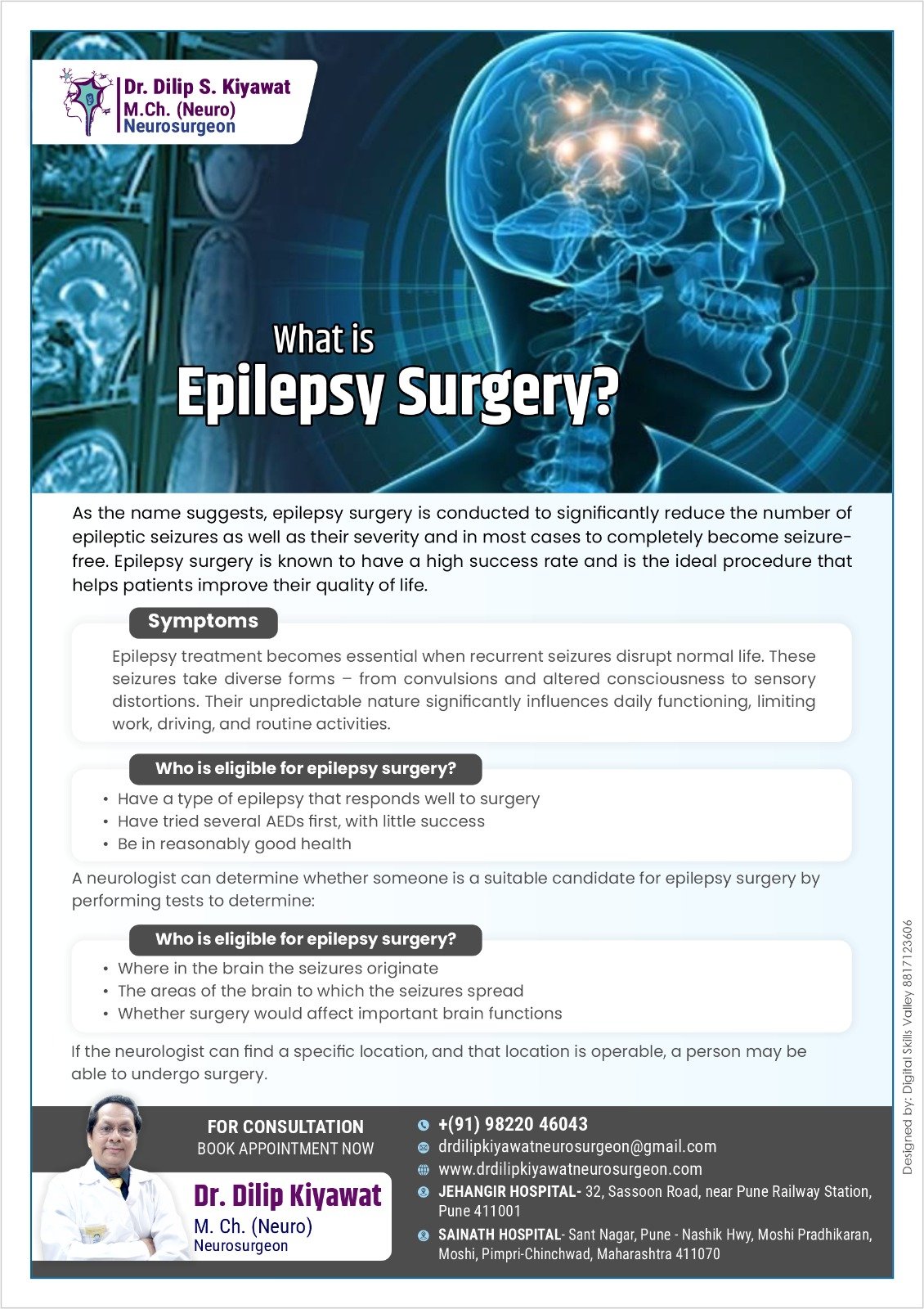
What is Epilepsy Surgery?
Informative patient education framework outlining when surgical resection is indicated, multidisciplinary pre-op workup, and long-term prognosis.
For consultation regarding drug-resistant seizures or epilepsy surgery options, reach Dr. Dilip Kiyawat at
-
Phone / Clinic Line +91 98220 46043
-
Website drdilipkiyawatneurosurgeon.com