Slipped (Herniated) Disc Surgery
SLIPPED (HERNIATED) DISC SURGERY
Intervertebral discs are fibro gelatinous structures that are interposed between the two vertebral bodies at each level and work like a shock absorber. The outer layer is a tough fibrous ring annulus that contains a gelatinous pulp in the middle called nucleus pulposus. Lumbar intervertebral disc prolapse, commonly known as a herniated disc or slipped disc, occurs when the nucleus pulposus protrudes through cracks in the annulus and presses on nearby nerves.
This condition is often caused by aging, wear and tear, or sudden injuries such as lifting heavy weights, playing strenuous sports, etc. Symptoms include lower back pain, sciatica (radiating leg pain), numbness, and weakness. Diagnosis involves clinical evaluation, along with imaging studies like MRI or CT scans.
Conservative & Surgical Care :- Conservative treatments such as rest, physical therapy, and pain management are initially employed. In more severe cases, when conservative measures fail to provide relief, surgical options may be considered to alleviate pressure on the nerves. Surgical options include microdiscectomy or endoscopic disc excision, both being Minimally Invasive techniques. Early diagnosis and a tailored treatment plan are essential for the effective management of lumbar disc prolapse and for restoring functional well-being.
MICROSURGICAL & ENDOSCOPIC DISC EXCISION
Relieving sciatic nerve compression, preserving disc height, and restoring pain-free spinal mobility
Causes
As people age, the intervertebral discs lose water content and become less flexible, making them more prone to herniation under physical strain or spinal loading.
Symptoms
Symptoms include lower back pain, sciatica (sharp radiating leg pain shooting below the knee), progressive numbness, tingling, and motor weakness.
Conservative treatments
Conservative treatments such as rest, physical therapy, targeted anti-inflammatory medications, and structured pain management protocols are initially employed.
Rehabilitation
Early Mobilization and a gradual return to normal activities as guided by the surgeon, followed by core stabilization exercises.
SLIPPED (HERNIATED) DISC SURGERY
Multidisciplinary treatment options tailored to the severity and longevity of disc displacement:
Pain Medications
Over-the-counter or prescription pain relievers. Exercises to strengthen core muscles and improve flexibility.
Early Mobilization
Gradual return to normal activities as guided by the surgeon. Exercises to strengthen the back and improve flexibility.
Epidural Steroid Injections
Anti-inflammatory medication injected into the affected area. Medications to relieve muscle spasms.
Body Mechanics Education
Learning proper techniques for lifting, bending, and sitting. Weight management and adopting spine-friendly habits.
Radiological Findings & Surgical Extraction
Authentic medical records from Dr. Dilip Kiyawat's microdiscectomy cases:
 Zoom
Zoom
L 4 - L 5 Slip Disc seen on mri
High-resolution sagittal MRI scan revealing focal posterior disc extrusion at the L4-L5 intervertebral segment.
 Zoom
Zoom
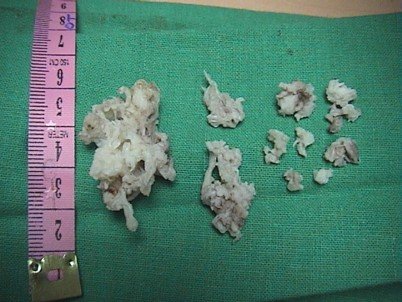
dISC mATERIAL rEMOVED fROM l4-l5 DISC SURGERY
Direct surgical photograph of the compressed herniated nucleus pulposus material excised cleanly through micro-incisions.
When Is Slipped Disc Surgery Necessary?
While over 80% of disc herniations resolve with conservative therapy, surgical microdiscectomy or endoscopic decompression is indicated when:
For consultation and appointment booking, you can reach Dr. Dilip Kiyawat at
-
Phone +91 98220 46043
-
Website drdilipkiyawatneurosurgeon.com